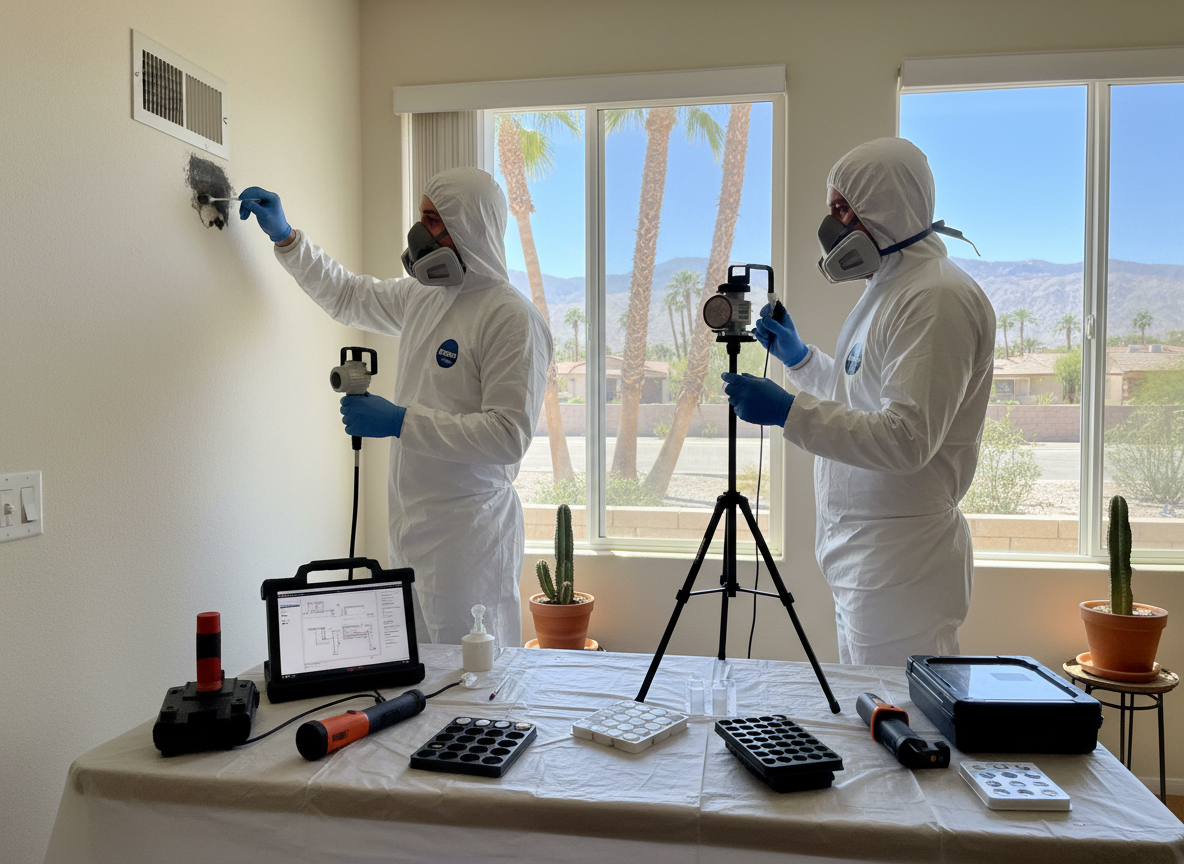
In North Palm Springs, air quality and mold testing must account for the region's hot desert climate where summer temperatures routinely exceed 110 degrees and force round-the-clock air conditioning. Constant cooling creates condensation inside older ductwork and attic spaces common in homes built from the 1960s onward along N Indian Ave and surrounding streets. Technicians sample both indoor and outdoor air to compare spore counts, because the dry climate outside can mask elevated levels inside walls or under flooring after even minor leaks. Testing also checks for hidden moisture from irrigation systems that many properties use to maintain landscaping in the arid Riverside County soil.
Homes near Desert Hot Springs often feature slab-on-grade construction with limited crawl spaces, so air sampling focuses on HVAC returns and supply vents where mold can travel throughout the house. Technicians use spore trap and tape lift methods calibrated for low-humidity environments, then send samples to an independent lab for species identification. Results frequently reveal Aspergillus or Penicillium linked to AC coil drip pans rather than obvious roof leaks. Owners in Palm Springs proper sometimes request repeat testing after monsoon remnants bring brief heavy rain that soaks stucco exteriors and finds its way behind window frames.
Testing protocols also note Riverside County requirements for documenting conditions before any remediation begins. Reports include particle counts, relative humidity readings at multiple points, and thermal imaging to locate temperature differentials that signal hidden moisture. This level of detail helps distinguish between normal desert dust and actual mold growth that requires targeted removal rather than whole-house treatments.
Technician insight
In North Palm Springs, the thing that catches most people out with Air quality and mold testing is how nonstop summer AC use creates condensation inside ducts and attics even when outdoor humidity stays below 20 percent. Older homes along N Indian Ave often have single-pane windows and minimal insulation that make the temperature swing worse, so the moisture hides until we sample the return air.
Condensation in North Palm Springs HVAC
A resident near Desert Hot Springs reported persistent odors after installing a new AC unit. Air sampling showed elevated spores at the main return. Thermal imaging located moisture on the supply plenum where cold air met the hot attic. The report guided targeted cleaning of the ducts and sealing of the plenum joints.
How it works
- 1
Site Walkthrough
Technician inspects HVAC systems, attics, and plumbing areas in North Palm Springs homes while noting signs of condensation from constant summer cooling.
- 2
Air and Surface Sampling
Spore traps and tape lifts are collected from multiple rooms plus an outdoor control sample to establish baseline desert conditions.
- 3
Laboratory Analysis
Samples are sent for identification and quantification, focusing on species common in Riverside County desert homes with older ductwork.
- 4
Detailed Report Delivery
Findings include humidity data, spore comparisons, and recommendations specific to the property's age and construction type.
Pricing
Cost depends on property size, number of samples, and whether HVAC or attic access is required.