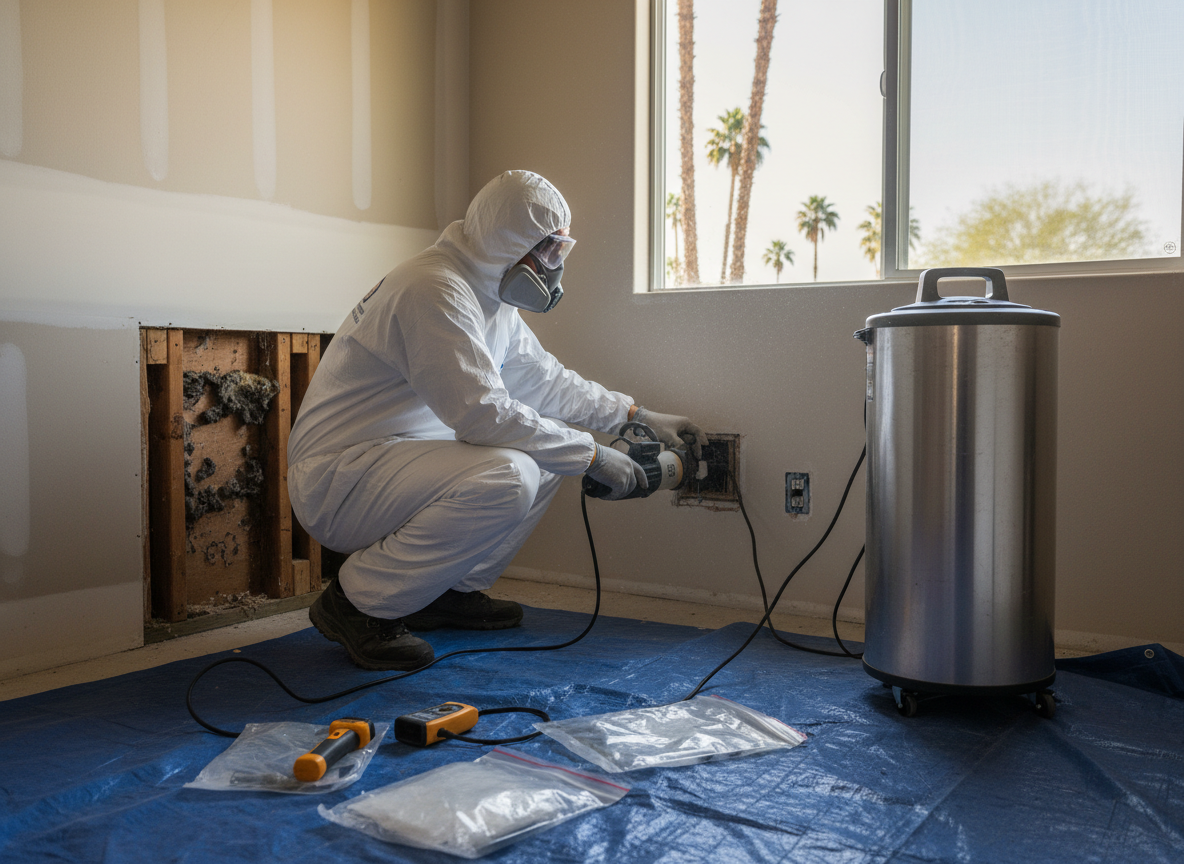
North Palm Springs sits in a hot desert climate where summer temperatures regularly exceed 110 degrees, forcing constant air conditioning use. This creates condensation inside older ductwork and around evaporator coils in mid-century homes common throughout the neighborhood and nearby Desert Hot Springs. Moisture collects in wall cavities and attic spaces when units short-cycle or drain lines clog, allowing mold to form behind drywall even when indoor air feels dry. Testing must target these hidden spots rather than relying on visible signs alone.
Homes along N Indian Avenue and surrounding streets often feature slab foundations with limited crawlspace access and single-pane windows that contribute to temperature swings. These conditions make moisture meter readings and thermal imaging essential to locate damp areas around plumbing penetrations and window frames. Air sampling inside living spaces and HVAC returns reveals spore levels that differ sharply from outdoor baselines in Riverside County, where wind-blown desert dust can mask indoor issues. Surface swabs from suspected areas confirm growth types before any remediation plan begins.
Testing protocols account for the fact that many North Palm Springs properties lack modern vapor barriers, allowing minor roof or irrigation leaks to travel far under stucco exteriors. Inspectors check both the structure and the HVAC system because evaporative coolers still present in some homes introduce additional humidity during shoulder seasons. Results guide whether containment or further investigation is needed, especially when residents report musty odors only during evening temperature drops.
Technician insight
In North Palm Springs, the thing that catches most people out with Mold testing near me is how quickly AC condensation builds in homes without proper attic ventilation during the long hot summers. Older slab homes near Indian Avenue often show elevated readings only in the return plenum even when living areas test clean.
Hidden Growth in North Palm Springs Attic
A homeowner near N Indian Avenue noticed a persistent musty smell only after sunset. Inspection revealed elevated moisture around the AC platform where the drain line had been rerouted years earlier. Air samples from the attic and master bedroom confirmed elevated spore counts. Targeted remediation followed the testing results and resolved the odor source.
How it works
- 1
Initial Consultation
Discuss symptoms and property history over the phone or on-site at the North Palm Springs location to determine sampling locations.
- 2
On-Site Inspection
Use moisture meters, thermal cameras, and visual checks in attics, walls, and HVAC components typical to local housing stock.
- 3
Sampling and Analysis
Collect air and surface samples for lab review to identify mold types and compare indoor versus outdoor concentrations.
- 4
Report Delivery
Provide written findings with photos and recommendations tailored to the specific conditions found in the tested areas.
Pricing
Pricing varies by square footage, number of samples required, and access difficulty in desert construction; call for an upfront quote.