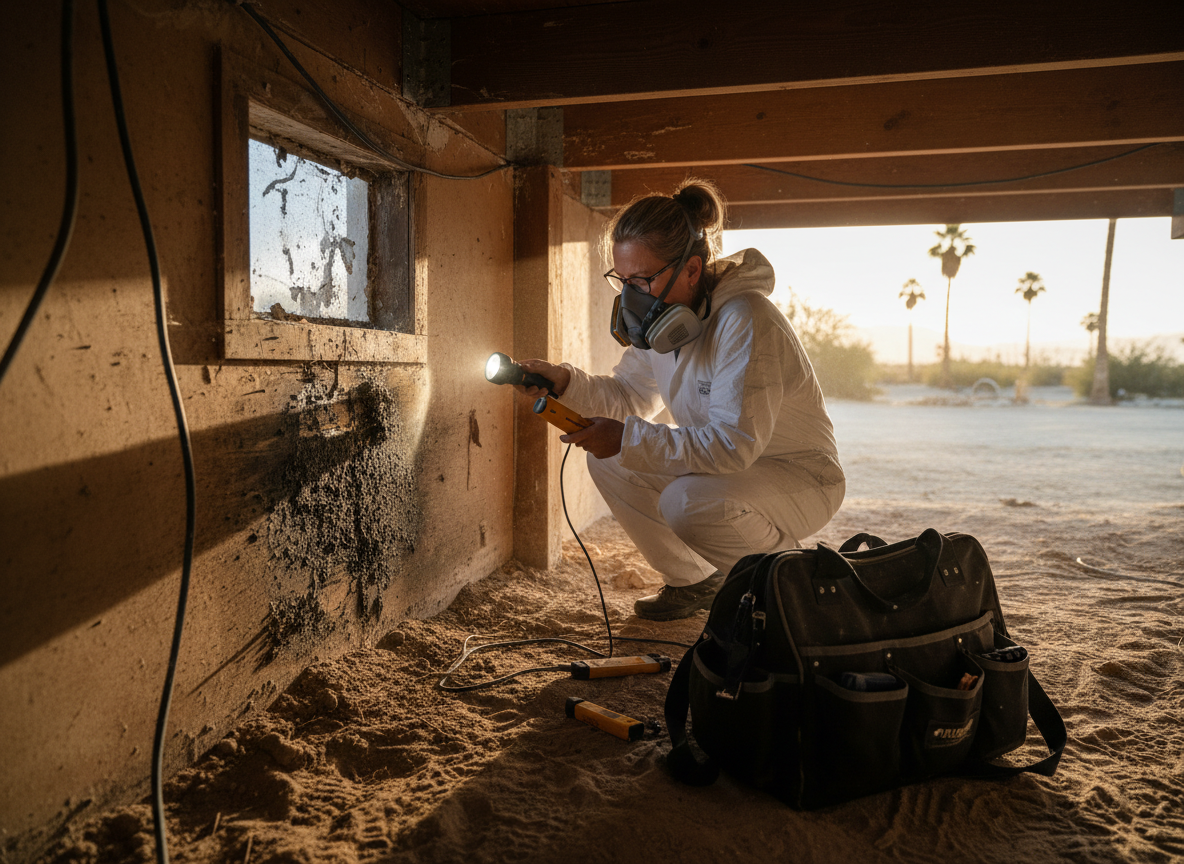
North Palm Springs sits in Riverside County where hot desert summers push air conditioners to run nonstop. Constant cooling creates condensation inside ductwork, attic spaces and wall cavities of the many mid-century ranch homes that line Indian Avenue and nearby streets. During a home mold inspection we use moisture meters and thermal imaging to locate these hidden damp zones before they trigger widespread growth.
Mild winters here rarely freeze pipes, yet occasional monsoon rains can send water under stucco or into poorly sealed flat roofs common in the area. We pay special attention to bathrooms, laundry rooms and any addition built onto original 1950s-1970s stock in North Palm Springs and adjacent parts of Desert Hot Springs. Edge cases include mold behind mirrored closet doors or inside evaporative cooler housings that many locals still use.
Palm Springs building codes require proper ventilation in new work, yet many existing homes predate those rules. Our inspection notes any blocked soffit vents or overloaded circuits that force AC units to short-cycle, raising indoor humidity. We also flag soil moisture against slab foundations where desert irrigation can keep the ground damp year-round, a frequent contributor to baseboard mold.
Seasonal Guidance
Summer inspections focus on attic insulation and duct boots where condensation peaks. Winter checks target any slow leaks from evaporative coolers that homeowners shut off but rarely drain completely.
Technician insight
In North Palm Springs the thing that catches most people out with home mold inspection is constant AC condensation inside poorly insulated attics of 1960s ranch houses; the dry desert air outside hides the fact that those ducts drip for months until a musty smell finally appears near Indian Avenue.
Hidden Attic Mold After AC Failure
Problem: musty odor in a North Palm Springs home after a summer AC outage. We found: condensation mold along ductwork in the unvented attic of a 1964 ranch house. What we did: full moisture mapping plus thermal scan that located the wet insulation. Outcome: source identified and contained before growth spread into living spaces.
How it works
- 1
Site Walkthrough
We start outside the North Palm Springs property, checking grading, irrigation lines and roof edges for obvious water entry points common after monsoon storms.
- 2
Interior Moisture Mapping
Inside we scan walls, ceilings and floors with moisture meters, paying extra attention to AC closets and bathrooms in the older housing stock along Indian Avenue.
- 3
Hidden Space Checks
Attics, crawl spaces and behind appliances are opened where safe; thermal imaging reveals temperature differences that signal active condensation in desert-cooled homes.
- 4
Findings Report
You receive a written summary with photos, moisture readings and clear next-step recommendations tailored to Riverside County construction practices.
Pricing
Pricing varies by home size, age and number of hidden spaces that require access in North Palm Springs properties.