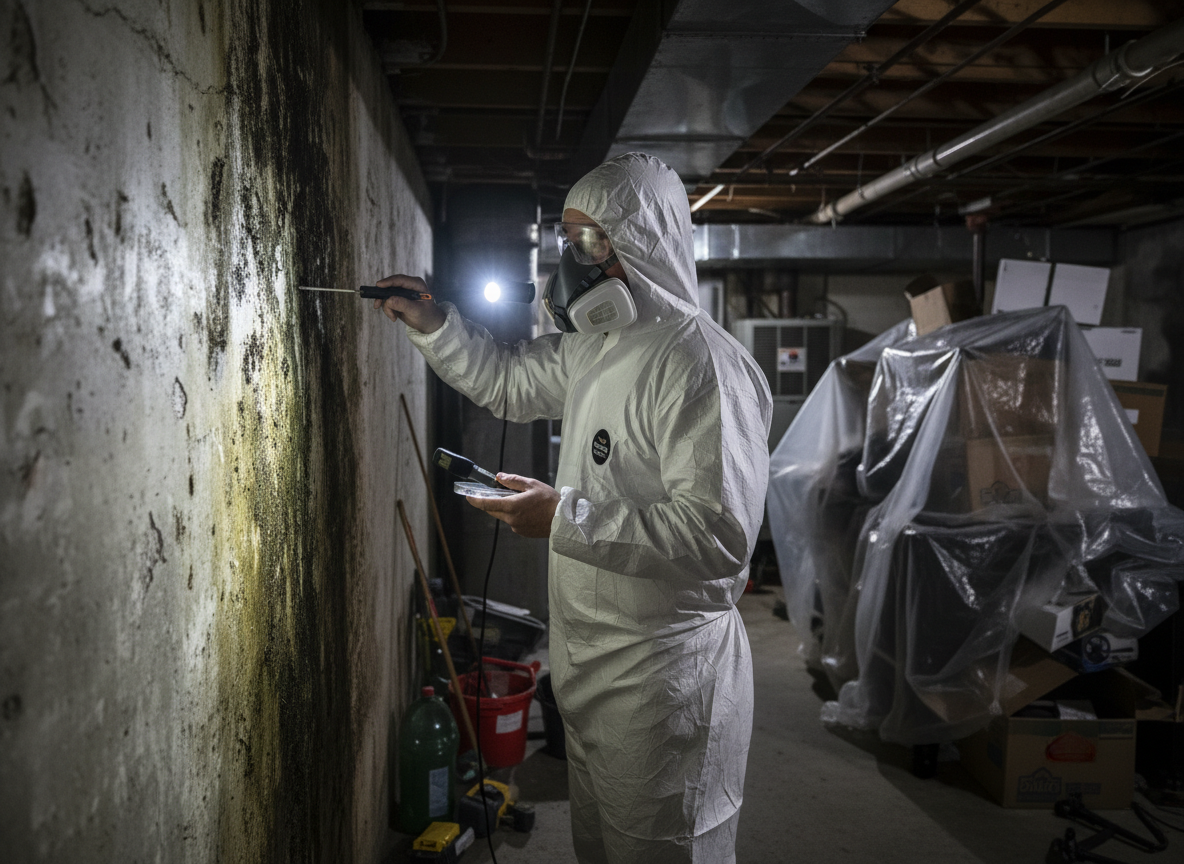
In North Palm Springs homes, basements often sit below grade in compacted desert soil that retains trace moisture from irrigation or rare winter rains. Older ranch-style and mid-century properties around North Palm Springs and Desert Hot Springs frequently have concrete block or poured walls that develop hairline cracks, allowing humid air from evaporative coolers to condense during mild winters. A proper inspection starts with moisture metering of walls and slabs, followed by thermal imaging to locate temperature differentials behind finished surfaces without unnecessary demolition.
Riverside County building practices from the 1960s onward left many basements with minimal vapor barriers and unsealed penetrations for plumbing and electrical. Hot summer temperatures drive residents to run dehumidifiers or portable AC units downstairs, which can mask active growth until musty odors reach living areas. Inspectors check behind water heaters, under stairwells, and around sump pits common in lower-lying lots near Indian Avenue. Air sampling is used only after visual and moisture data indicate hidden colonies.
Homeowners in Palm Springs and North Palm Springs often confuse surface dust with mold because desert winds carry fine silt indoors. True growth requires sustained humidity above 60 percent, usually from roof runoff pooling against foundations or leaking supply lines. The inspection includes mapping all affected materials, noting whether drywall, carpet pad, or wooden framing is involved, and documenting conditions that could affect remediation scope before any removal begins.
Technician insight
In North Palm Springs the thing that catches most people out with Basement mold inspection is how quickly condensation forms on cool slab edges during the first cool nights after a long hot summer, especially in homes built before modern vapor barriers were standard around Indian Avenue and nearby Desert Hot Springs.
Hidden Growth Behind Finished Wall
A North Palm Springs homeowner noticed a persistent earthy smell after running a portable AC unit all summer. Inspection found elevated moisture along the north foundation wall where irrigation overspray had soaked the soil for years. Thermal imaging revealed cooler patches behind drywall; samples confirmed Penicillium growth. The report outlined targeted removal and drying steps that prevented spread into the rest of the home.
How it works
- 1
Initial Assessment
Review property history and visible signs of moisture while walking the basement perimeter and adjacent crawlspaces.
- 2
Moisture Mapping
Use pin and pinless meters plus infrared cameras to identify damp zones on walls, floors, and behind cabinets.
- 3
Sampling and Documentation
Collect surface or air samples where growth is suspected and photograph every finding for the written report.
- 4
Report and Recommendations
Deliver findings with photos, moisture readings, and next-step options tailored to the home's construction.
Pricing
Inspection cost depends on square footage, access difficulty, and whether sampling is required; upfront quotes provided before work begins.