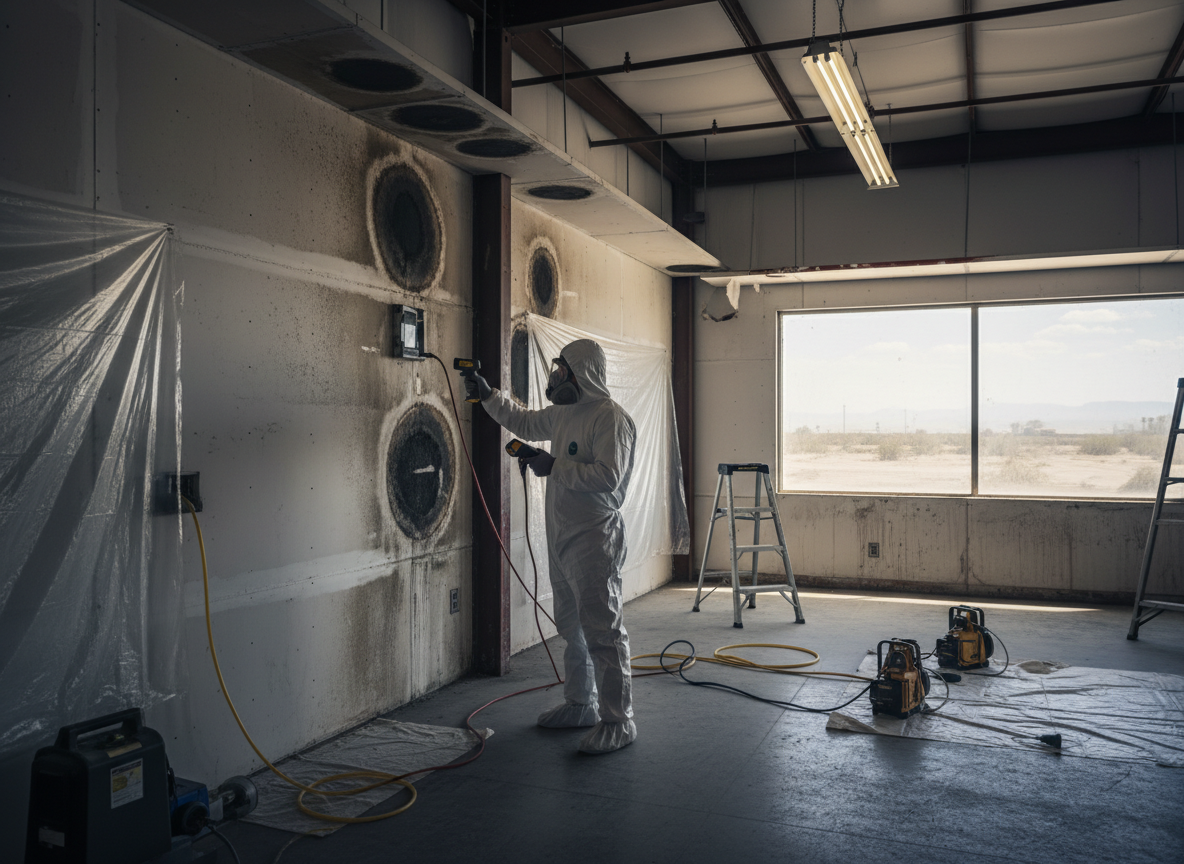
Commercial properties in North Palm Springs often feature flat-roof warehouses and older retail buildings from the 1970s onward that trap heat in HVAC plenums. During peak summer temperatures above 110 degrees, even small condensate line failures create persistent moisture behind drop ceilings and in wall cavities. Inspectors must map airflow patterns through rooftop units and check for gypsum board degradation that spreads faster in the dry air once water is introduced.
Riverside County commercial codes require documentation of moisture sources before any remediation plan. In Desert Hot Springs and North Palm Springs, inspectors routinely find mold colonies along slab edges where irrigation lines for landscaping cross under loading docks. Thermal imaging combined with moisture meters reveals hidden saturation in concrete that standard visual checks miss, especially after rare winter rains pool against building foundations.
Edge cases include mold growth inside walk-in coolers of restaurants along Indian Avenue where constant temperature swings defeat standard dehumidification. Inspectors also examine fire-suppression systems in strip malls near Palm Springs city limits, as stagnant water in pipes can seed spores into adjacent office spaces. All findings must reference actual water intrusion points rather than assuming typical residential crawlspace patterns.
Handling Desert-Specific HVAC Risks
Commercial HVAC systems in North Palm Springs run continuously through summer, creating condensation on metal ducts that drip into insulation. Inspections include disassembly of at least two access points per unit and air sampling from return plenums to detect amplification sites that only appear under load.
Technician insight
In North Palm Springs the thing that catches most people out with commercial mold inspection is assuming the desert climate prevents mold. The real issue is rooftop AC units dumping condensate into insulation during 110-degree summers, and older flat-roof buildings along Indian Avenue hold that moisture for months before anyone notices.
Strip Mall Unit Near Indian Avenue
A retail space showed musty odors after a summer condensate leak. Inspection located saturation in the drop ceiling and insulation above the sales floor. Targeted air sampling confirmed elevated spores tied to the HVAC return. The owner received a clear map of affected sections and a remediation plan that avoided full ceiling removal.
How it works
- 1
Site Walkthrough
Technician tours the full commercial footprint noting roof penetrations, HVAC locations, and past water events reported by staff.
- 2
Moisture Mapping
Use meters and infrared cameras on walls, ceilings, and slabs to locate active or residual moisture without demolition.
- 3
Air and Surface Sampling
Collect samples from multiple zones including HVAC returns and compare to outdoor baseline in the desert air.
- 4
Report and Recommendations
Deliver written findings with photos, moisture readings, and prioritized next steps for the property owner.
Pricing
Pricing depends on square footage, number of HVAC units, and access difficulty; request an upfront quote based on your specific property.