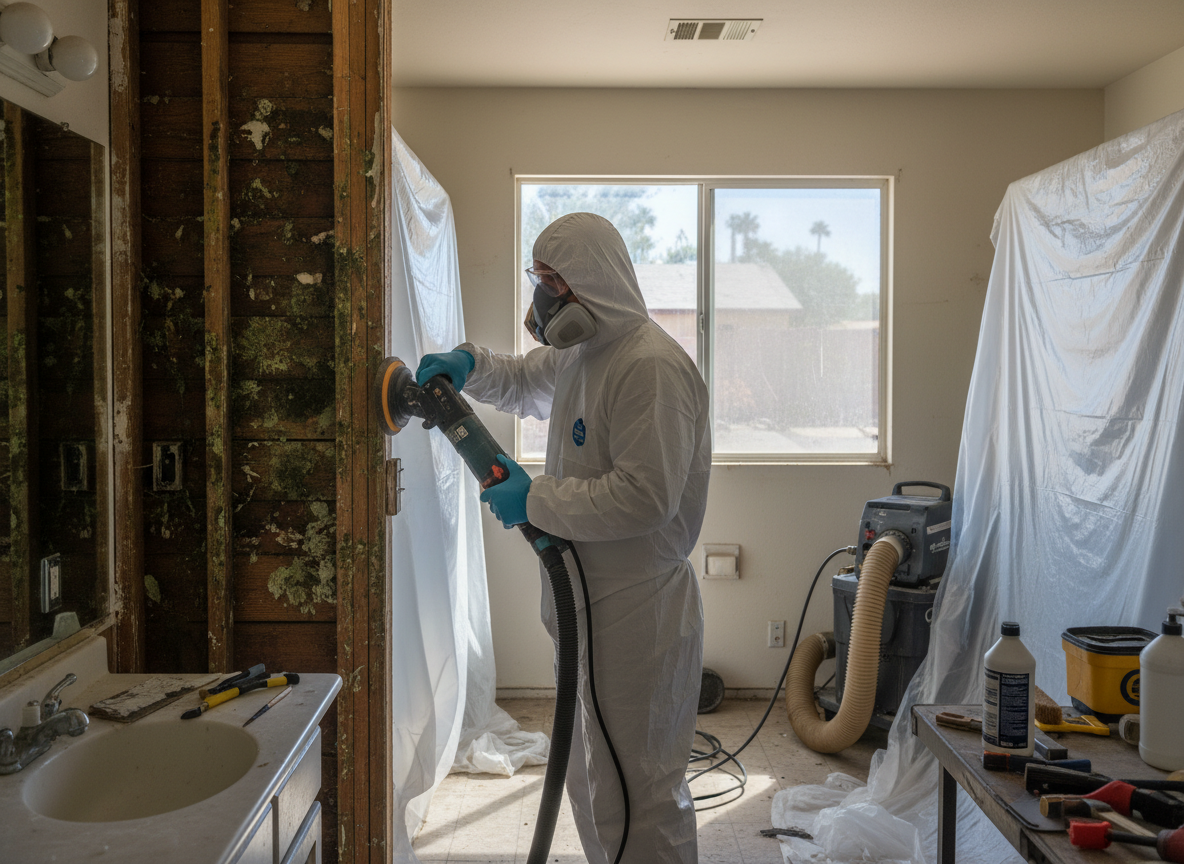
North Palm Springs sits in a hot desert climate where summer temperatures routinely exceed 110 degrees, driving heavy air conditioning use that creates condensation inside walls and attics. Homes built before the 1990s often lack modern vapor barriers, allowing moisture from swamp coolers or roof leaks to linger in stucco and drywall assemblies common along N Indian Ave and nearby Desert Hot Springs corridors. Abatement here requires isolating affected cavities without disturbing the thermal envelope that keeps indoor temperatures manageable during peak heat.
Riverside County building practices in the North Palm Springs area frequently include slab-on-grade construction with minimal crawlspace ventilation. When monsoon remnants or irrigation overspray introduce water under the slab, mold colonies establish along the perimeter where cool night air meets warm soil. Remediation crews must account for these microclimates, using negative air machines sized for single-story ranch layouts rather than multi-level designs found closer to central Palm Springs.
Mold abatement in this region also intersects with dust and sand infiltration that can carry spores into HVAC returns. Technicians routinely pull registers in homes near the 10 Freeway corridor to inspect for hidden growth in flex duct runs that have degraded from UV exposure and extreme temperature swings. Containment protocols differ from coastal jobs because negative pressure must be maintained against constant wind-driven pressure changes.
Seasonal patterns matter: mild winters allow homeowners to delay inspection until spring, when rising humidity from evaporative coolers reactivates dormant colonies. Addressing growth before the first 100-degree week prevents rapid spread through shared wall cavities typical in the tract housing north of Dillon Road.
Technician insight
In North Palm Springs the thing that catches most people out with mold abatement is how quickly AC condensate lines clog with desert dust and restart growth inside wall cavities within weeks of the last rain. Older slab homes along N Indian Ave often have no vapor barrier under the perimeter, so irrigation overspray travels under the concrete and reactivates colonies every time the evaporative cooler kicks on. Skipping the line flush and perimeter check means the same patch grows back before summer peaks.
Hidden Growth Behind AC Closet
A North Palm Springs homeowner noticed musty odor near the hallway AC closet after a mild winter. Inspection revealed moisture from a clogged condensate line had wicked into the drywall and under the slab edge. We isolated the closet, removed the wet sections, flushed the line, and ran drying equipment for 48 hours. Post-clearance testing confirmed levels below outdoor baselines, and the system has stayed dry through the first heat wave.
How it works
- 1
Initial Assessment
Technician arrives within hours, maps moisture with meters, and identifies HVAC and plumbing pathways specific to North Palm Springs construction.
- 2
Containment Setup
Plastic barriers and negative air machines isolate the work zone while accounting for desert wind loads and single-story layouts.
- 3
Source Removal
Affected drywall, insulation, and trim are cut out and bagged for disposal, focusing on slab edges and attic spaces common in local homes.
- 4
Drying and Verification
Dehumidifiers and air movers run until readings meet industry dry standards, followed by post-remediation sampling.
- 5
Final Clearance
Homeowner receives written report and guidance on preventing recurrence tied to local AC use and irrigation practices.
Pricing
Upfront quotes provided after inspection; scope varies with extent of hidden growth and access challenges in desert homes.